
Specified Skilled Worker (SSW) Visa Japan 2026: Requirements, Jobs, Fields & Latest Updates
The Specified Skilled Worker (SSW) visa allows foreign nationals to work in industries facing labor shortages in Japan.
After five years of operation, the system is currently undergoing partial revisions in response to ongoing labor shortages. Based on the “Comprehensive Measures for Acceptance of Foreign Workers” approved by the Japanese Cabinet in January 2026, some industries and job categories are being updated.
In addition, a new system called ESDP (Employment for Skill Development Program) will be launched in April 2027. This program will enable more foreign workers to gain skills while working and transition smoothly into the SSW visa.
ESDP replaces the current Technical Intern Training Program (TITP).
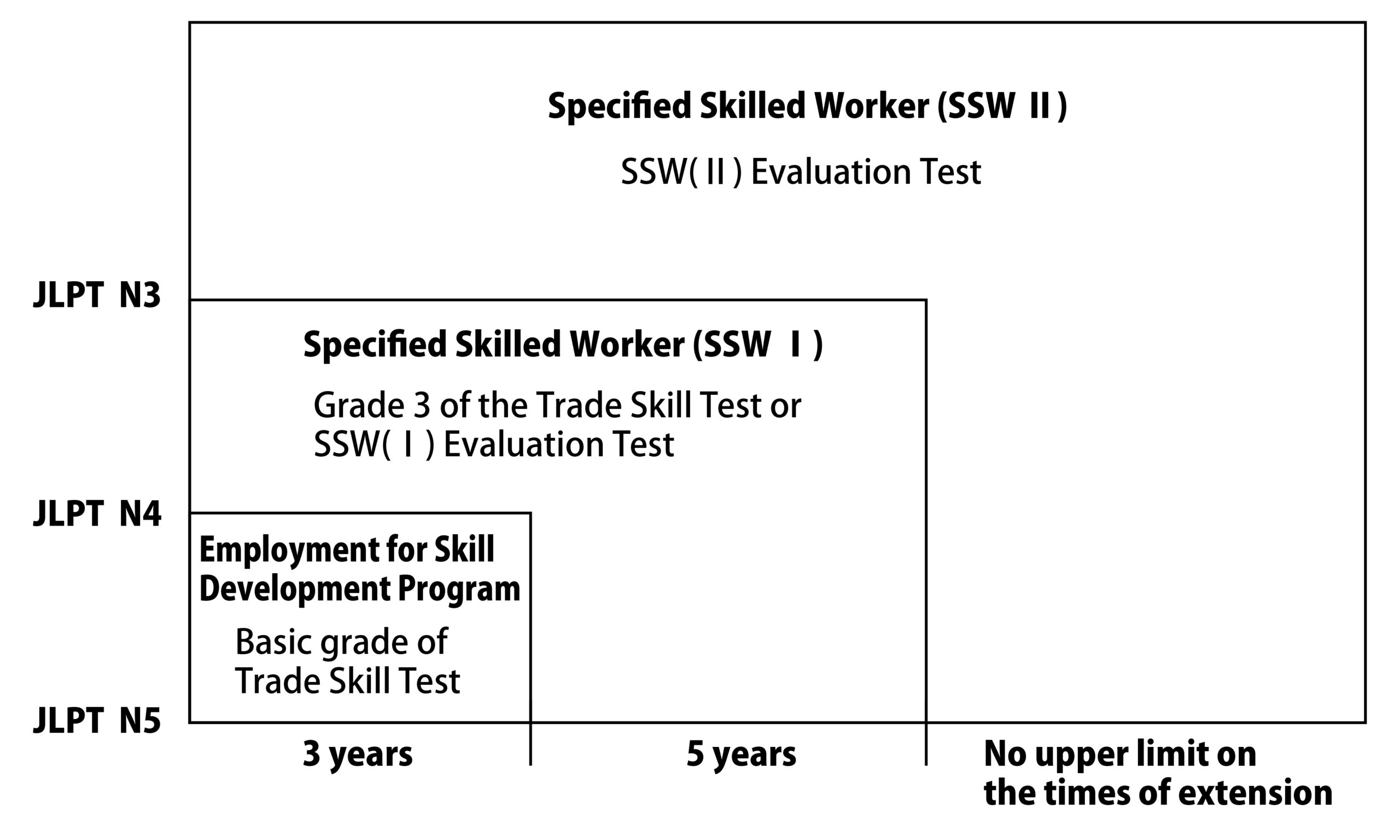
SSW Type 1 and Type 2
The SSW visa is divided into two categories based on skill level:
| Item | SSW Type 1 | SSW Type 2 |
|---|---|---|
| Skill Level | Basic knowledge or experience | Advanced, skilled level (exam required) |
| Period of Stay | Up to 5 years (total) | No limit (renewable long-term) |
| Family Accompaniment | Not allowed | Allowed (spouse and children) |
| Japanese Language | Required (exam-based) | Not required (exempt after Type 1) |
| Support | Mandatory support by employer | No mandatory support |
Eligible Fields
Following a Cabinet decision, the following three new sectors have been added (details are still being finalized):
| Field | Category | Notes | ||
|---|---|---|---|---|
| Nursing care | ESDP | SSW Type 1 | – | |
| Building cleaning | ESDP | SSW Type 1 | SSW Type 2 | |
| Construction | ESDP | SSW Type 1 | SSW Type 2 | |
| Shipbuilding & marine industry | ESDP | SSW Type 1 | SSW Type 2 | |
| Automobile maintenance | ESDP | SSW Type 1 | SSW Type 2 | Expanded to include bodywork |
| Accommodation | ESDP | SSW Type 1 | SSW Type 2 | |
| Automobile transportation | – | SSW Type 1 | – | |
| Agriculture | ESDP | SSW Type 1 | SSW Type 2 | |
| Fisheries | ESDP | SSW Type 1 | SSW Type 2 | |
| Forestry | ESDP | SSW Type 1 | – | |
| Wood industry | ESDP | SSW Type 1 | – | |
| Food service | ESDP | SSW Type 1 | SSW Type 2 | |
| Industrial product manufacturing | ESDP | SSW Type 1 | SSW Type 2 | Expanded scope (e.g., furniture, concrete) |
| Food manufacturing | ESDP | SSW Type 1 | SSW Type 2 | Includes seafood processing |
| Aviation | – | SSW Type 1 | SSW Type 2 | |
| Railway | ESDP | SSW Type 1 | – | Includes station/train cleaning |
| Linen supply | ESDP | SSW Type 1 | SSW Type 2 | Newly added |
| Logistics & warehousing | ESDP | SSW Type 1 | SSW Type 2 | Newly added |
| Resource recycling | ESDP | SSW Type 1 | SSW Type 2 | Newly added |
Skill Tests and Japanese Language Requirements
There are two main pathways to obtain the SSW visa:
Exam route:
Applicants must pass both a skills test and a Japanese language test (N4 level or above).
Transition from Technical Intern Training:
Those who have successfully completed Technical Intern Training (Type 2) are exempt from these tests.
From April 2027, a smoother transition from the new ESDP system will also be introduced.
| Status | Japanese Level (CEFR) | Test |
|---|---|---|
| SSW Type 2 | B1 | JLPT N3 |
| SSW Type 1 | A2 | JLPT N4 / JFT-Basic |
| ESDP | A1–A2 | JLPT N5 |
JFT-Basic is a test designed for SSW applicants.
From August 2026, new levels (A1 and A2) will be introduced.
Partner Countries and Support System
To obtain an SSW visa, your home country must have a bilateral agreement with Japan. Applicants typically work through sending organizations in their home country and registered support organizations in Japan.
Employers are required to provide the following 10 types of support:
- Pre-arrival guidance
- Airport pickup and drop-off
- Housing support
- Daily life orientation
- Assistance with public procedures
- Japanese language learning opportunities
- Consultation and complaint handling
- Support for interaction with Japanese people
- Job change support (if necessary)
- Regular interviews and follow-ups
Can You Change Jobs?
Changing employers is allowed, but immigration procedures are required.
- Within the same field:
No additional skills test is required. You can transfer directly (e.g., food service to another food service company). - Different field:
You must pass the relevant skills test for the new industry (e.g., agriculture to food service requires passing the food service test). - Japanese language:
Once you obtain SSW Type 1 status, you do not need to retake the language test when changing jobs.
Summary
The SSW system is becoming increasingly important as Japan expands its acceptance of foreign workers.
While the overall structure remains largely the same, three major changes have been introduced:
- Three new industries have been added
- A cap on the number of accepted workers has been introduced
- The new ESDP system will replace the Technical Intern Training Program
The number of companies and workers under the SSW system is steadily increasing. However, due to government-imposed caps, new applications in the food service sector have been suspended as of April 13, 2026.
Looking ahead, more companies are expected to participate in hiring foreign workers, creating more opportunities for job seekers.
In some industries, large companies dominate hiring. In others, such as the railway sector, companies collaborate to train and recruit workers across the entire industry.
Ultimately, it is important for you to carefully choose:
- Which field to enter
- Which company to work for
While challenges remain—such as recruitment fees for workers—improvements are gradually being made. ASEAN countries are also working toward eliminating worker-paid fees and removing illegal brokers.
For more details:
https://www.ssw.go.jp/
Check here for information on SSW-related exams:
Information on Tests Related to the Specified Skilled Worker Program
By Hajime Saito
X: @hajimesaitoYJC