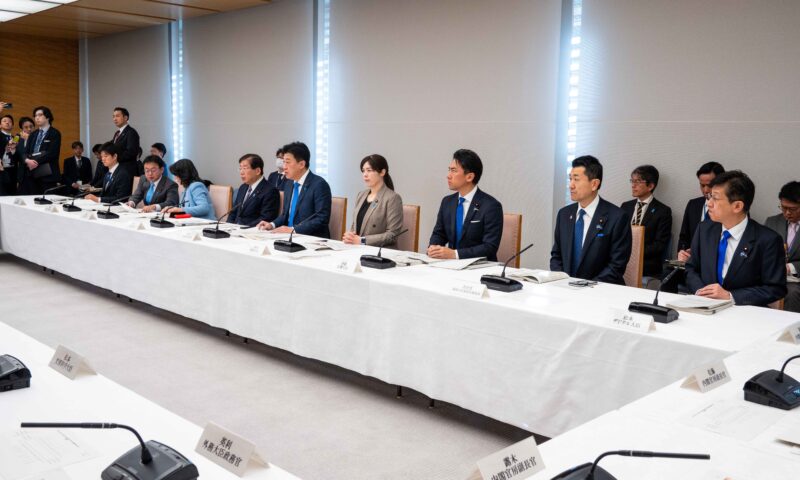
Photo: Prime Minister’s Office of Japan, Source: Cabinet Secretariat (Government of Japan)
On January 23, the Japanese government convened a ministerial meeting on the acceptance of foreign nationals and the realization of an orderly and inclusive society, and formally approved the following:
- The contents of the Comprehensive Measures for the Acceptance of Foreign Nationals and Orderly Coexistence
- A Cabinet decision on the sector-by-sector operational policies for the Specified Skilled Worker Program (SSW) and the Employment for Skill Development Program (ESDP)
While Japan will continue accepting foreign workers to address labor shortages, the decision places strong emphasis on system optimization and stricter oversight.
In this Cabinet decision, the government defined the target industries for the Employment for Skill Development Program (ESDP)—which will replace the Technical Intern Training Program (TITP)—and set intake caps through fiscal year 2028.
Intake Caps Through FY2028
The existing Technical Intern Training Program (TITP) will be abolished, and the Employment for Skill Development Program (ESDP) will officially begin in April 2027.
Under the new framework, the intake cap for ESDP is set at 430,000 workers over the two-year period starting in April 2027. When combined with the intake capacity under the Specified Skilled Worker Program (SSW), Japan will be able to accept up to a maximum of 1.23 million foreign workers.
Intake numbers will be managed by sector and by period, based on domestic labor shortages and productivity improvement efforts. The government made it clear that this is not an unlimited intake policy, but a controlled system designed to supplement labor shortages where necessary.
Target Sectors for SSW and ESDP
The government expanded the number of designated industrial sectors eligible for foreign workers from 16 to 19 sectors. Among these, 17 sectors will be covered by the new ESDP framework.
Below is the list of the 19 designated sectors:
- Nursing care
- Shipbuilding and marine engineering
- Motor vehicle transportation services (SSW only)
- Food service industry
- Building cleaning
- Automobile maintenance
- Agriculture
- Wood industry
- Construction
- Accommodation
- Fisheries
- Forestry
- Manufacturing of industrial products (expanded scope)
- Aviation (SSW only; expanded scope)
- Railway (expanded scope)
- Food and beverage manufacturing (expanded scope)
- Linen supply (new sector)
- Logistics warehousing (new sector)
- Resource recycling (new sector)
Details such as projected intake numbers for each sector will be published sequentially in future “Insights” articles.
Transitional Measures and Coexistence Policies
The above outlines the officially approved sector-specific operational policies for the SSW and ESDP. What, then, is included in the Comprehensive Measures for the Acceptance of Foreign Nationals and Orderly Coexistence?
Job Mobility and Transitional Measures
Under the ESDP, foreign workers who meet certain conditions—such as Japanese language proficiency and skill levels—will be allowed to change jobs within the same industry based on their own wishes.
However, from a human resource development perspective, a job-change restriction period of one to two years will be imposed depending on the industry.
For foreign nationals currently residing in Japan under the Technical Intern Training Program (TITP), the government plans to implement transitional measures that take into account their residence status and career paths. The transition will not involve any abrupt termination due to the system change.
Stricter Rules for Permanent Residency and Naturalization
While intake is being expanded, the government is adopting a stricter stance toward long-term settlement.
For permanent residency, the government indicated it will consider introducing Japanese language proficiency requirements and apply stricter screening. Permanent residents currently account for approximately 20% of Japan’s nearly four million foreign residents.
In addition, operational rules for naturalization will be revised, extending the residency requirement from the current five years to ten years.
Measures to address unpaid taxes and social insurance contributions will also be strengthened. Information on non-payment will be shared with the Immigration Services Agency and used in residence status renewal decisions. The policy package also includes responses to unpaid medical expenses and mechanisms to encourage private medical insurance enrollment prior to entry.
Coexistence Measures and Land Ownership Debate
As part of coexistence efforts, the government will consider creating programs that allow foreign residents to learn Japanese language skills and social customs, helping prevent isolation within local communities. Opportunities for children to acquire basic Japanese before entering school are also included.
Regarding foreign land ownership, the Cabinet decision did not introduce specific regulations at this stage. However, the government will continue discussions from a national security perspective by reviewing legislative justifications and referencing systems in other countries. An expert panel is expected to be established as early as February, with a basic policy framework to be compiled by summer.
The government stated that the guiding principle of these measures is the realization of a society in which both Japanese citizens and foreign nationals can live safely and securely under the rule of law, and prosper together.
By simultaneously setting intake caps and strengthening oversight, this Cabinet decision signals a clear shift in Japan’s foreign worker policy—from quantity to quality, and from expansion to management.
Details for each industry will be published in future “Insights” articles.
By Hajime Saito
Related article:
Inside Japan’s New ESDP: What the Government’s Basic Policy Reveals