
If you want to live and work in Japan, choosing the right legal status of residence is your first and most important step.
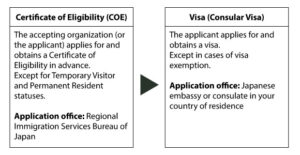
To enter Japan for purposes other than short-term stays such as tourism, you will generally need a Certificate of Eligibility. This document confirms that you meet the requirements for your intended activities in Japan. In other words, before entering Japan for a long-term stay, you must obtain an appropriate legal status — this is called a Status of Residence.
Japan has many different statuses of residence, each with its own permitted activities and period of stay.
This page provides an overview of the main categories.
For detailed information, please refer to each individual status page.
Note: Detailed pages for each status will be published gradually.
Flow of Immigration Procedures in Japan
Procedures Before Entering Japan
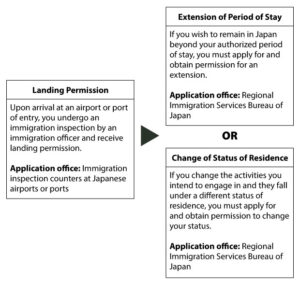
Procedures After Entering Japan
What Do You Want to Do in Japan?
For long-term stays, you need to have a general idea of what kind of activities you plan to engage in while living in Japan.
However, it is perfectly fine if you have not decided everything yet. You can find your own path step by step, depending on your current stage of life.
The following stages are not exhaustive, but they represent common situations.
Stage 1: I’m Not Sure Yet
You may not have a clear plan yet, but you love Japan and would like to live here for a while to discover what you truly want to do.
In that case, a Working Holiday visa or a Student status of residence may be suitable options.
By working part-time under a Working Holiday program, or by studying at a university or language school, you can learn Japanese language, culture, and social customs. During that time, you can also determine whether building a career in Japan is the right choice for you.
Stage 2: I Want to Study
If you would like to gain specialized knowledge at a university or improve your Japanese language skills, a Student status of residence would be appropriate.
While studying your chosen field and improving your language ability, you can also prepare for employment in Japan.
In recent years, many matching events and job fairs targeting international students have been held. If your goal is to work in Japan, the Student status offers a flexible pathway to various industries and career options.
Stage 3: I Want to Work in a Specific Field
If you already know what you want to do — for example, working in agriculture, nursing care, railway infrastructure, or other specialized fields — the next step is to determine which status of residence fits your chosen profession.
You can apply for job openings offered by agencies that support foreign employment in Japan. After passing interviews and required examinations, you can begin working in your desired field.
Stage 4: I Want to Live in Japan While Working Remotely
With the rise of digital nomad lifestyles, more people are able to work from anywhere in the world. Some may wish to live in Japan while continuing their work for employers in their home country.
However, in Japan, it is generally difficult to reside long-term solely based on work conducted for a foreign company.
In principle, you are expected to engage in some form of recognized activity within Japan — such as employment, business operations, or other approved contributions.
That said, you do not need to give up. By building connections with Japanese companies or exploring alternative pathways, opportunities can still be found.
List of Statuses of Residence in Japan
Below is an overview of the main statuses of residence available in Japan.
Also read:
What Comes After Technical Intern Training in Japan?
Status of Residence for Working
Statuses of residence that allow you to work in Japan.
| Status | Main Activity | Period | Notes |
|---|---|---|---|
| Highly Skilled Professional(高度専門職) | Advanced professional activities in research, academic instruction, specialized/technical work, or business management under Japan’s point-based system. | Type (i): 5 years Type (ii): Indefinite |
|
| Engineer / Specialist in Humanities / International Services(技術・人文知識・国際業務) | Professional work requiring specialized skills or knowledge in engineering, humanities, or international services. | 5 years, 3 years, 1 year, or 3 months |
|
| Specified Skilled Worker (i / ii)(特定技能) | Employment in designated industries facing labor shortages. | Type (i): Up to 5 years Type (ii): Renewable (possible path to permanent residency) |
|
| Technical Intern Training(技能実習) | Participation in practical skill training under an approved technical intern plan. | Up to 5 years (depending on stage) |
|
| Business Manager(経営・管理) | Managing or operating a business in Japan. | 5 years, 3 years, 1 year, 4 months, or 3 months |
|
| Intra-company Transferee(企業内転勤) | Transfer to a Japanese branch from an overseas office of the same company. | 5 years, 3 years, 1 year, or 3 months |
|
| Instructor(教育) | Teaching at elementary, junior high, high schools, or equivalent educational institutions. | 5 years, 3 years, 1 year, or 3 months | Typically for language teachers and instructors in the public school system. |
| Medical Services(医療) | Medical practice in Japan, such as physician, dentist, or nurse (with Japanese license). | 5 years, 3 years, 1 year, or 3 months | Requires appropriate Japanese national medical license. |
| Nursing Care(介護) | Providing nursing care services or supervising care work at a public or private organization in Japan as a certified care worker. | 5 years, 3 years, 1 year, or 3 months | Requires Japanese national certification as a Certified Care Worker (Kaigo Fukushishi). |
| Skilled Labor(技能) | Work requiring advanced industrial or trade skills. | 5 years, 3 years, 1 year, or 3 months | Requires substantial professional experience in the field. |
| Legal / Accounting Services(法律・会計業務) | Providing legal or accounting services that require professional qualifications under Japanese law. | 5 years, 3 years, 1 year, or 3 months | Includes lawyers, certified public accountants, and registered foreign legal consultants. |
| Professor(教授) | Research or teaching at universities or equivalent higher education institutions. | 5 years, 3 years, 1 year, or 3 months | |
| Researcher(研究) | Conducting research at public or private organizations in Japan. | 5 years, 3 years, 1 year, or 3 months | |
| Entertainer(興行) | Performance-related activities such as theater, music, dance, sports, or other entertainment activities (excluding business management). | 5 years, 3 years, 1 year, 6 months, 3 months, 30 days | Examples: actors, singers, dancers, professional athletes. |
| Art(芸術) | Income-generating artistic activities such as music, fine arts, literature, or other creative arts (excluding entertainer activities). | 5 years, 3 years, 1 year, or 3 months | Examples: composers, painters, authors. |
| Official(公用) | Official activities conducted for foreign governments or international organizations. | 5 years, 3 years, 1 year, 3 months, 30 days, or 15 days | |
| Diplomat(外交) | Diplomatic activities carried out by foreign government representatives and their family members. | Duration of diplomatic assignment | |
| Press(報道) | Journalistic activities, including news gathering and reporting, based on a contract with a foreign media organization. | 5 years, 3 years, 1 year, or 3 months | Examples: foreign correspondents, reporters, camera operators. |
| Religion(宗教) | Religious activities conducted by clergy dispatched to Japan by foreign religious organizations. | 5 years, 3 years, 1 year, or 3 months | Examples: missionaries and religious workers sent by overseas religious organizations. |
Status of Residence for Study and Training
Statuses that are not intended for working. In principle, paid work is not permitted.
| Status | Main Activity | Period | Notes |
|---|---|---|---|
| Student(留学) | Study at universities, colleges, vocational schools, high schools, language schools, or other recognized educational institutions in Japan. | Up to 4 years and 3 months |
|
| Trainee(研修) | Participation in training programs at public or private organizations in Japan to acquire skills or knowledge (non-employment activities). | 1 year, 6 months, or 3 months |
|
Designated Activities
Statuses designated on a case-by-case basis, such as Working Holiday programs.
| Status | Main Activity | Period | Notes |
|---|---|---|---|
| Working Holiday(ワーキングホリデー) | Activities individually designated by the Minister of Justice, typically allowing young people to travel in Japan while engaging in incidental work. | 5 years, 3 years, 1 year, 6 months, 3 months, or a period individually designated by the Minister of Justice (not exceeding 5 years) |
|
| Foreign Nurses(外国人看護師) | Activities individually designated by the Minister of Justice for foreign nurse candidates entering Japan under specific bilateral agreements. | 5 years, 3 years, 1 year, 6 months, 3 months, or a period individually designated by the Minister of Justice (not exceeding 5 years) |
|
| Caregiver Candidates(介護福祉士候補者) | Activities individually designated by the Minister of Justice for foreign caregiver candidates working toward national certification. | 5 years, 3 years, 1 year, 6 months, 3 months, or a period individually designated by the Minister of Justice (not exceeding 5 years) |
|
| Domestic servants of diplomats(外交官等の家事使用人) | Activities individually designated by the Minister of Justice for domestic employees serving diplomats or certain foreign officials residing in Japan. | 5 years, 3 years, 1 year, 6 months, 3 months, or a period individually designated by the Minister of Justice (not exceeding 5 years) |
|
Status of Residence for Living and Family Purposes
Statuses with no restrictions on work, offering relatively broad freedom. However, the screening requirements are strict.
| Status | Main Activity | Period | Notes |
|---|---|---|---|
| Permanent Resident(永住者) | No restriction on activities in Japan. | Indefinite |
|
| Long-Term Resident(定住者) | Activities individually designated by the Minister of Justice for long-term residence based on special circumstances. | 5 years, 3 years, 1 year, 6 months, or designated period |
|
| Spouse or Child of a Japanese National(日本人の配偶者等) | Daily life activities as a spouse or child of a Japanese national residing in Japan. | 5 years, 3 years, 1 year, or 6 months |
|
| Spouse or Child of a Permanent Resident(永住者の配偶者等) | Daily life activities as a spouse or child of a permanent resident in Japan. | 5 years, 3 years, 1 year, or 6 months |
|
| Dependent(家族滞在) | Daily life activities as a dependent spouse or child of a foreign resident holding an eligible status of residence. | Up to 5 years |
|
Short-Term and Other Activities
For short stays or non-employment purposes.
| Status | Main Activity | Period | Notes |
|---|---|---|---|
| Temporary Visitor(短期滞在) | Short-term stay for tourism, business meetings, visiting relatives, attending conferences, or similar non-remunerated activities. | 15, 30, or 90 days |
|
| Cultural Activities(文化活動) | Unpaid academic, artistic, or cultural activities, including research or study of traditional Japanese culture. | 3 years, 1 year, 6 months, or 3 months |
|