
ESDP is a new work-based training system designed to lead foreign workers directly to the Specified Skilled Worker (SSW) visa.
The Employment for Skill Development Program (ESDP) is a new system that will replace the Technical Intern Training Program (TITP) starting in spring 2027. It was created to address the issues associated with the TITP.
While the TITP was positioned as a program for international contribution, largely separate from Japan’s labor market, ESDP is designed as a pathway into the Specified Skilled Worker system. The maximum period of stay is 3 years.
- TITP: A training program aimed at transferring skills for international contribution
- ESDP: A training program aimed at securing workforce within Japan
The basic operational structure is similar to TITP. As of early March 2026, the operational guidelines have finally been released, and further details are still being finalized.
This is an employment-based system with enhanced protections for foreign workers.
Who is this program for?
ESDP is designed for people who want to work and build a stable life in Japan in industries facing labor shortages.
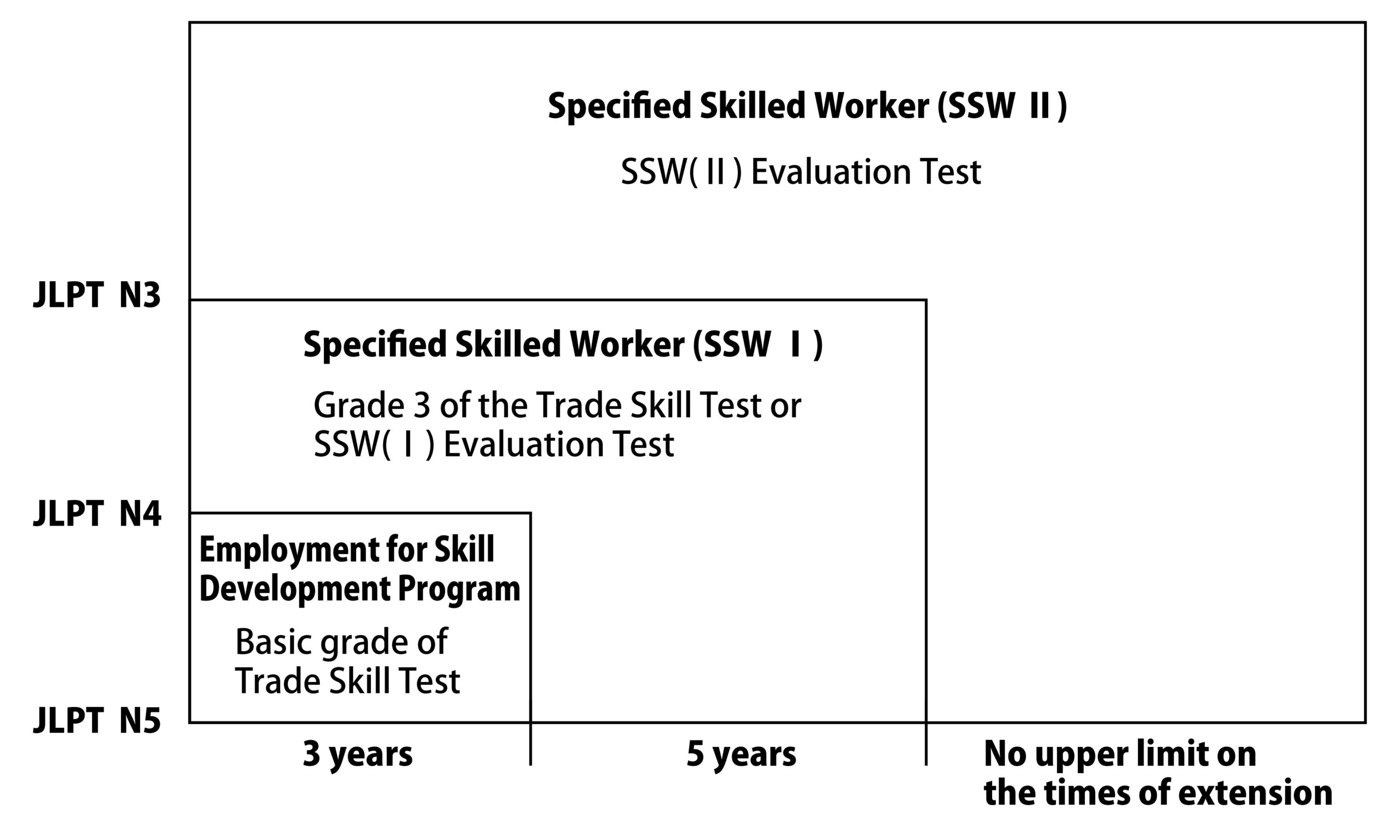
It allows you to work with the goal of transitioning to the Specified Skilled Worker (SSW) visa. After up to 3 years under ESDP, you can move to SSW Type 1, making your career path clearer.
For example, you can gain solid skills in fields such as agriculture or fisheries and build a long-term career.
The following diagram shows how ESDP leads to SSW and long-term work in Japan.
Eligible Fields
So, what kind of work can you do under ESDP?
Because the goal is to transition to SSW Type 1, you can work in the same industries as SSW.
The table below shows whether ESDP and SSW Type 1 are available in each field.
As shown, some fields (such as aviation and automobile transportation) are not included in ESDP. This is because they require licenses from the beginning of employment.
These fields are the same as SSW because the goal is to transition to SSW after 3 years.
| Field | ESDP | SSW Type 1 |
|---|---|---|
| Nursing care | ✓ | ✓ |
| Building cleaning | ✓ | ✓ |
| Construction | ✓ | ✓ |
| Shipbuilding & marine industry | ✓ | ✓ |
| Automobile maintenance | ✓ | ✓ |
| Accommodation | ✓ | ✓ |
| Automobile transportation | ✗ | ✓ |
| Agriculture | ✓ | ✓ |
| Fisheries | ✓ | ✓ |
| Forestry | ✓ | ✓ |
| Wood industry | ✓ | ✓ |
| Food service | ✓ | ✓ |
| Industrial product manufacturing | ✓ | ✓ |
| Food manufacturing | ✓ | ✓ |
| Aviation | ✗ | ✓ |
| Railway | ✓ | ✓ |
| Linen supply | ✓ | ✓ |
| Logistics & warehousing | ✓ | ✓ |
| Resource recycling | ✓ | ✓ |
What are the skill tests like?
To transition to SSW Type 1, you must pass:
- A basic-level evaluation test after Year 1
- An advanced-level evaluation test after Year 3
Unlike TITP, which required trade skill tests, ESDP uses evaluation-based testing to measure skill development over time.
The difficulty and format of the tests vary by field. More details are expected to be announced around June 2026.
Japanese Language Requirements
Before starting work, you must have:
- A1 level (JLPT N5), or
- Equivalent Japanese language training
During the 3-year period, your Japanese skills are expected to improve step by step.
To transition to SSW Type 1, you need:
- A2.2 level (JLPT N4 or equivalent)
For the nursing care field, A2.2 (N4) is required before starting work.
If you have not passed a Japanese test, you must complete:
- 160 hours of Japanese training before entry
- 160 hours after entry
Alternatively, you may complete 320 hours after arrival.
| Status | Japanese Level | Test |
|---|---|---|
| SSW Type 2 | B1 | N3 |
| SSW Type 1 | A2.2 | N4, JFT-Basic |
| ESDP | A2.1 (for transfer) A1 |
N5 |
JFT-Basic is a test designed for SSW applicants.
From August 2026, new levels (A1 and A2.1) will be added to JFT-Basic.
Sending Countries and Management System
As with TITP, you can participate in ESDP only if your country has an official agreement with Japan.
You must apply through:
- A sending organization in your home country
- A supervising/support organization in Japan
The employer (implementing organization) pays fees to the sending organization.
However, this amount must not exceed twice the worker’s monthly salary.
This rule is intended to eliminate exploitative brokers who charge excessive fees.
As a result, workers can come to Japan with greater safety and transparency.
Can you change jobs (transfer)?
You cannot change industries, but you can transfer within the same field.
In general, transfers are allowed after working for more than one year, subject to conditions:
- Japanese level of A2.1
- Within the company’s transfer quota (approximately 1/3)
- The employer must cover transfer-related costs (details not finalized)
Although the system allows transfers, these conditions may make it difficult in practice.
In reality, these conditions may make transfers difficult, even though the system allows it.
Transfers are always allowed in cases of serious issues such as labor violations.
Worker Protection System
Employers cannot dismiss workers without valid reasons such as serious misconduct or retirement.
If unfair dismissal occurs, the company will be banned from hiring under ESDP for one year.
This strengthens protection against abuse.
Companies are also required to assign:
- Technical instructors
- Lifestyle support staff
This helps create a better working environment.
Employers are also responsible for supporting Japanese language learning.
Even if paid leave has been used up, workers must be allowed to return home temporarily using unpaid leave.
Transitional Measures from TITP
Since ESDP will start in April 2027 and still involves uncertainties such as coordination with sending countries, a transition period will be implemented.
For approximately 3 months:
- TITP and ESDP will run in parallel
The final intake of TITP trainees will be those entering Japan in June 2027.
Future Schedule
As of early March 2026, only the operational guidelines have been released, and detailed rules are still being finalized.
- June 2026: More detailed rules expected
- September 2026: Applications from companies begin
- Around October 2026: Recruitment interviews likely to start
ESDP will become the main entry route for foreign workers in Japan, so understanding it early is essential.
By Hajime Saito
X: @hajimesaitoYJC