

Direction of the Employment for Skill Development Program and the National Basic Policy
The Basic Policy, approved by the Cabinet in March 2025, more clearly outlines the philosophy and operational guidelines of the new system.
This policy shows that the government’s goal is not merely to accept labor, but to develop human resources and build a more inclusive society.
Toward a System that Welcomes Foreign Workers as Colleagues
The Cabinet decision clearly states that the government will develop and secure human resources with a certain level of expertise and skills not only in specialized and technical fields, but also in fields that have traditionally been considered simple labor.
In other words, Japan is transforming from a country that borrows labor to a country that develops and works with people.
Position of the Development Employment System
The Employment for Skill Development Program (ESDP) is closely linked with the Specified Skilled Worker System and is positioned as a system for developing the skills required for Specified Skilled Worker (SSW) status (i).
This allows workers to acquire practical skills through three years of work and smoothly transition to Specified Skilled Worker Status 1 upon completion.
The target fields (development employment industries) of the program will be limited to industries suitable for human resource development through work, and fields requiring licenses or qualifications and where it is difficult to gain practical experience will be excluded.
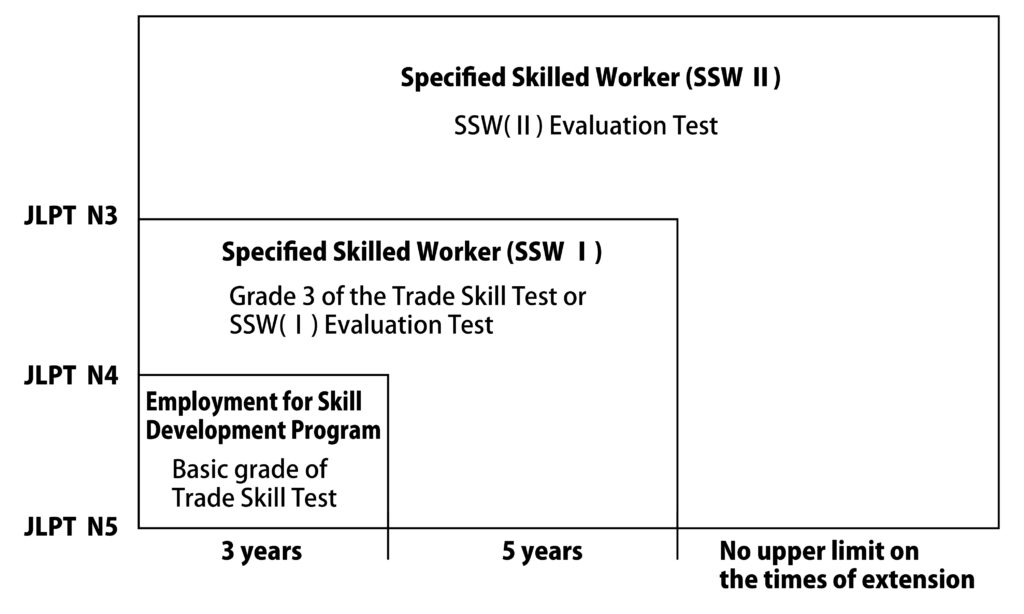
Figure: Career Path from Employment for Skill Development (ESDP) to Specified Skilled Worker (SSW)
Acquire basic skills and Japanese language proficiency (N5-N4) through development employment,
Step up from Specified Skilled Worker Status 1 (SSW I) to Specified Skilled Worker Status 2 (SSW II).
Upgrading to SSW II removes the limit on the period of stay, allowing for long-term work.
Clarification of Employment Status and Transfer Rules
Under the new system, full-time, direct employment will be the norm.
In addition, a policy has been announced in which employees will be allowed to transfer (change workplaces) at their own request in unavoidable circumstances or after a certain period of time (generally one year or more).
This will help workers leave abusive or non-compliant workplaces, ensuring a safer and fairer work environment.
Strengthened Japanese Language Education and Skill Assessment
Foreign participants in the ESDP will be required to achieve at least Level A1 (equivalent to N5) of the Japanese Language Education Framework upon entry. The goal is to achieve Level A2 (equivalent to N4) upon completion.
In addition, a system will be introduced to gradually assess their skill acquisition during their employment, with employees taking exams such as the Basic and Level 3 Trade Skills Tests.
The new system clearly states that the costs of these exams and training courses will, in principle, be borne by the accepting company, reducing the financial burden on the foreigners themselves.
National-Local Cooperation and Thorough Elimination of Brokers
In addition, to ensure the proper operation of the program, a tripartite collaboration system will be established between the national government, local governments, and supervisory support organizations.
Furthermore, the bill also clearly stipulates the elimination of unscrupulous intermediaries (brokers) and the transparency of sending costs based on bilateral memorandums of understanding (MoCs) with sending countries.
This is a key point in correcting the high sending costs and opaque intermediary structure that were issues with the previous Technical Intern Training Program.
Now at a Turning Point for the System
The ESDP marks a clear shift—from a system focused on “working” to one centered on learning, growth, and long-term career development.
There is still a preparation period until the official implementation in April 2027.
During this time, the program design will be further refined, and target industries and support systems will be established.
Let’s keep an eye on future developments so that foreigners can have a more secure and hopeful future working in Japan.
From Technical Intern Training to ESDP: Japan’s New Foreign Worker Roadmap