If you are planning to work in Japan, understanding the average salary is essential.
How much can you earn if you work in Japan?
Let’s take a look at the real average salary data.
Salary by Age and Gender
In recent years, income inequality in Japan has been increasing. While some people see little to no salary growth, others experience significant increases.
According to the National Tax Agency’s Survey on Private Sector Salaries (2024), only 6.2% of workers earn over 10 million yen annually. In contrast, 43.2% of workers earn between 3 million and 6 million yen.
Although some top-performing companies offer starting salaries exceeding 6 million yen for new graduates, such cases are still very rare.
| Age Group | Overall Average | Male | Female |
|---|---|---|---|
| 20–24 | ¥2.77 million | ¥2.95 million | ¥2.58 million |
| 25–29 | ¥4.07 million | ¥4.38 million | ¥3.70 million |
| 30–34 | ¥4.49 million | ¥5.12 million | ¥3.62 million |
| 35–39 | ¥4.82 million | ¥5.74 million | ¥3.51 million |
| 40–44 | ¥5.16 million | ¥6.30 million | ¥3.59 million |
| 45–49 | ¥5.40 million | ¥6.63 million | ¥3.69 million |
| 50–54 | ¥5.59 million | ¥7.09 million | ¥3.63 million |
| 55–59 | ¥5.72 million | ¥7.35 million | ¥3.56 million |
| 60–64 | ¥4.73 million | ¥6.04 million | ¥2.94 million |
Source: National Tax Agency, “Survey on Private Sector Salaries (2024)”
Note: These figures include bonuses.
Monthly Living Cost in Japan
Simply converting salaries into foreign currencies can be misleading.
To better understand income in Japan, it is important to look at actual living costs.
When you receive a salary in Japan, around 20–25% is deducted for taxes and social insurance. These payments are mandatory, and employers typically handle them on behalf of employees.
- Health Insurance & Pension: Covers medical expenses and future pension benefits
- Employment Insurance: Provides support in case of unemployment
- Income Tax: Calculated based on taxable income
- Resident Tax: Approximately 10% of the previous year’s income
This means that about 75–80% of your gross salary remains after deductions.
From this amount, you will need to cover daily living expenses such as:
- Rent: Around ¥80,000–¥100,000 in major metropolitan areas
- Utilities: Around ¥10,000–¥20,000
- Food: Around ¥40,000–¥70,000 (depending on lifestyle)
- Medical Expenses: Around ¥10,000–¥20,000
- Communication (Phone & Internet): Around ¥8,000–¥20,000
- Daily Necessities: Around ¥5,000–¥10,000
- Clothing: Around ¥10,000–¥20,000
Although these costs vary depending on location and lifestyle, they typically account for about 60% of your salary, based on data from the Family Income and Expenditure Survey (2025).
In other words, about 15–20% of your income remains available for savings, leisure, and other discretionary spending.
Example Budget (Single, Late 20s)
Let’s look at a realistic example of a single person in their late 20s living in a metropolitan area.
If the annual salary is ¥3.84 million, the monthly gross salary would be approximately ¥320,000. This is considered a reasonable income level for this age group.
As shown in the chart below:
- Taxes and social insurance account for about 20%
- Rent is around ¥90,000 for a small apartment
- Food costs are about ¥45,000 per month
- Utilities are approximately ¥13,000
This means that roughly 20% of the salary is available for dining out, entertainment, or unexpected expenses.
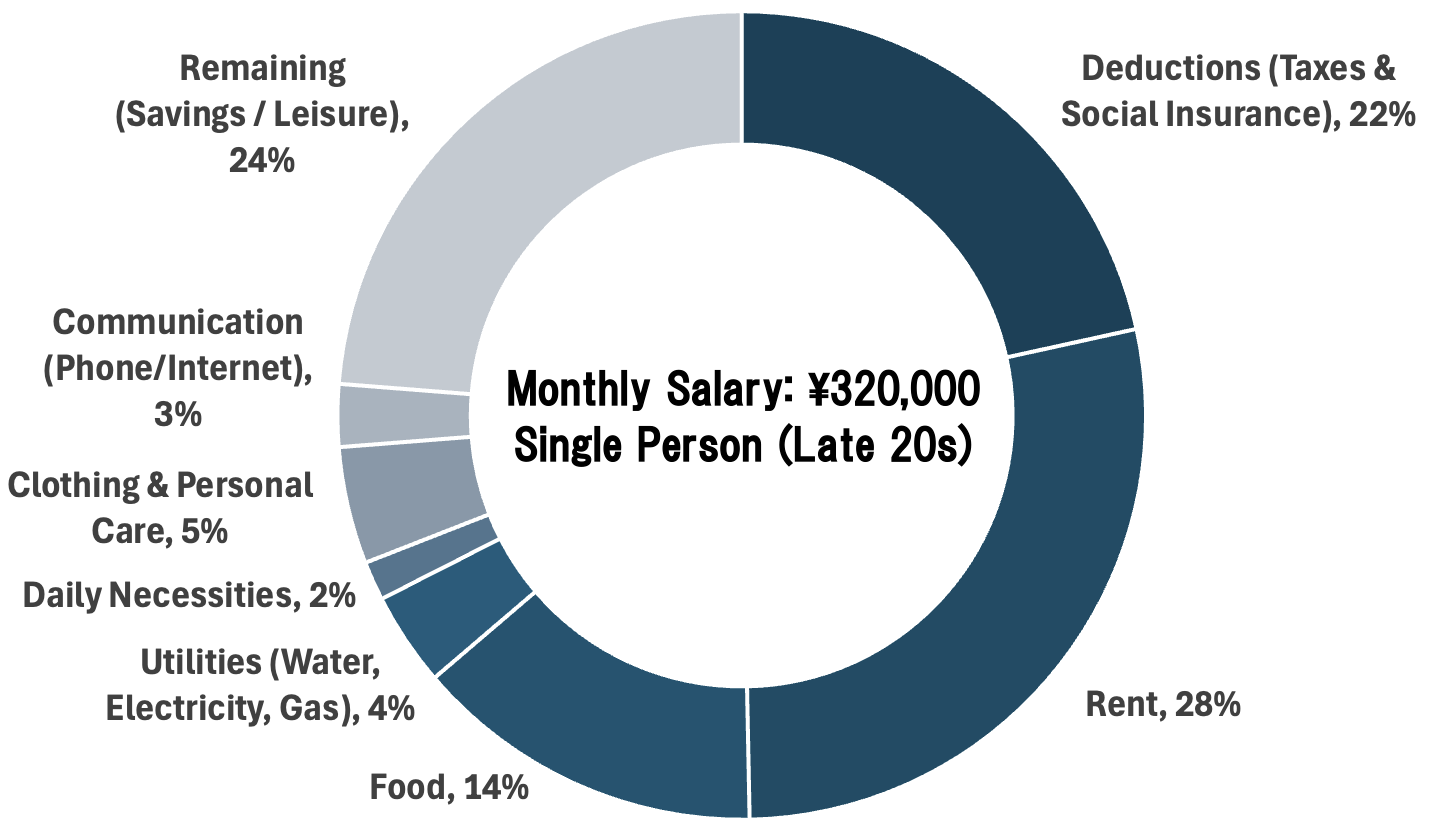
Source: Based on data from the National Tax Agency (2024) and the Statistics Bureau of Japan (2025).
Is Japan’s Salary High or Low?
Do you think salaries in Japan are high or low?
Income levels vary significantly depending on your skills, profession, and the performance of your employer. The figures presented here are only general guidelines.
Ultimately, the value of working in Japan depends on what you are looking for.
Some people may prioritize cultural experiences and lifestyle, even if salaries are modest. Others may aim to build a high-income career and seize new opportunities.
Use this information as a reference to help guide your decision.
By Hajime Saito
X: @hajimesaitoYJC
Next Read:
How Much Do Japanese Office Workers Spend on Lunch?